queer. trans. religion.
(a journal… and so much more)
religion? gender? sexuality?
…it’s complicated
journal previews

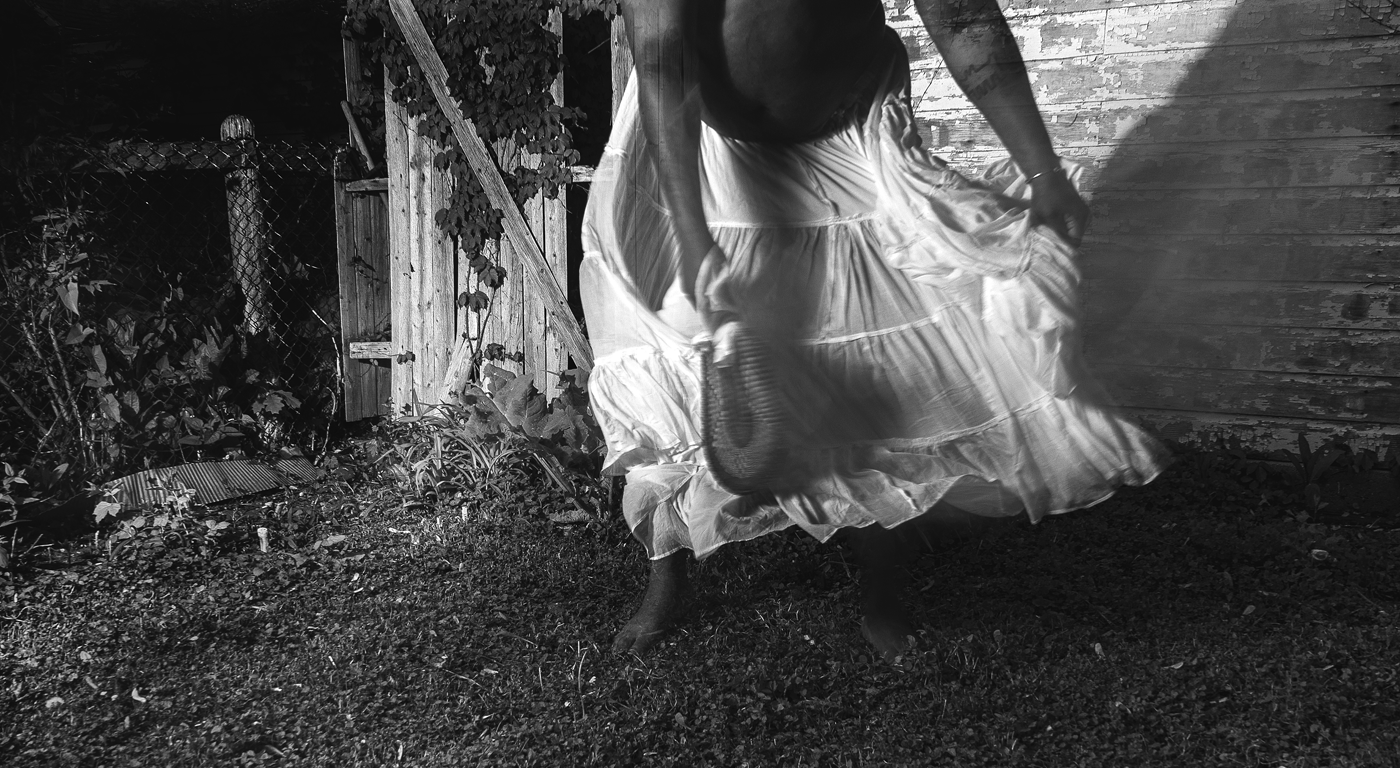
Moments of Truth is a series of five photographs that are about my experiences being outed as a Korean American queer nonbinary person, especially in a conservative and religious household. In Korean society, where conservative and traditional attitudes dominate the people, discrimination and prejudice is prevalent against LGBTQ+ people and communities. Queerness is seen as taboo, with any discussion being kept silent and discouraged—even being censored. Moments of Truth touches upon these realities, specifically my struggles between expressing myself and maintaining my relationships to my family—as well as the explosive conflicts that occurred when I was outed. The titles of the individual photographs are taken from the verbal exchanges between family members and me (“Please don’t tell them,” “It does not get better,” “Forgive me,” and so on). The interaction between myself and the clothes (that act as stand-ins for my family) represents the power dynamics between us. With this internal conflict between my kin and myself, the colors of these photographs are muted and reference the color of my flesh. The implied nudity and blurred, frenzied motion throughout the series evoke the vulnerability and desperation I felt in begging my kin to accept me. These photographs serve to depict and reveal moments of power, loss, secrecy, and agency in the domestic and psychological spheres of the Korean American household as a queer person.
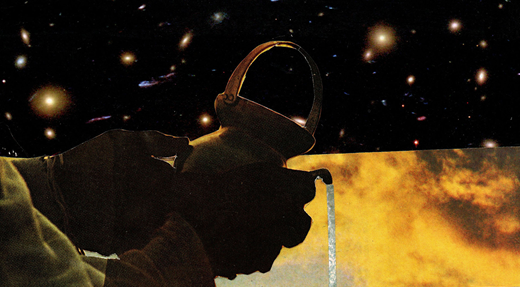
I embrace world-building as a spiritual art practice. My collage practice cites Octavia Butler’s mandate to “create your own worlds” and “write yourself in.”1 My work also responds to another Black woman speculative fiction writer, N. K. Jemisin, who wondered—as the Jetsons glided through a predominantly white utopia in the upper atmosphere—“What happened to the people beneath the clouds?”2 The world beneath the clouds that I conjure with paper collages using vintage Black ephemera is rooted at the intersection of Blackness, queerness, peace, and piety. It is a world where supreme beings are diverse and within our reach, visible and tangibly involved in the Earth realm, longing for us unconditionally as we are seeking them. […]
I show up uncommanded
to the steps of the Lower East Side mikve fantasizing about bleeding
into the pool clouding the living waters with my eggsome feet and menstrual rot all the cricks in my neck gossiping
until my sex leaks, apparent to the women gathered behind glass doors
go for the blood, the semen, the veins go for the babies you failed to create!
press a button and the mikve lady checks her back for errant hairs the Knife may now Bride […]
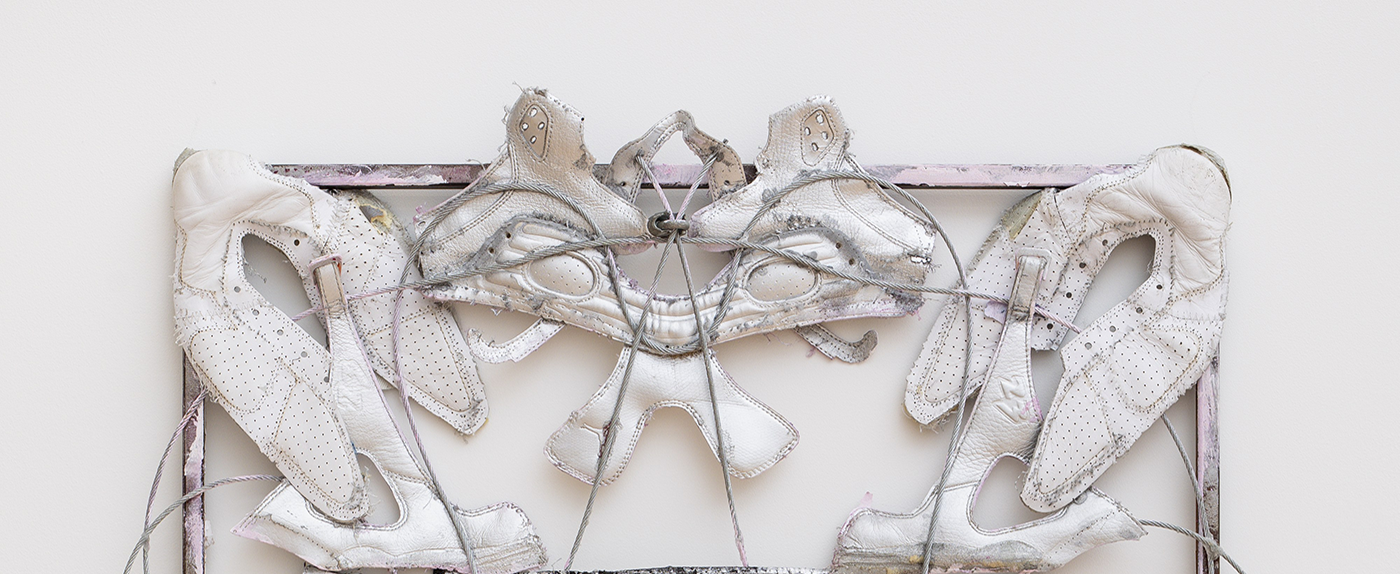
When I started working with Air Jordans, I was thinking about my childhood experience with sneaker culture and the ways it provided a script for men to follow and relate to one another, though I did not feel like I could match a certain gender performance that was expected of me. Deconstructing the shoes allows the psychological process of reconciling my oneness with, and difference from, the world I grew up in. I want to change how these shoes can exist in the world; maybe, in a way, I could exist with them outside of the gender expectations that were attached to them.
Through conversations with curator and writer Serubiri Moses, I have related the work to diasporic religions, Santeria specifically. Though I am not a practitioner, the practice holds much influence in my family in the Dominican Republic and diasporically, through music, through colloquialisms, and sometimes through spiritual practices. We spoke about how some Afro-Indigenous faith traditions interpolated Catholic iconography introduced through colonial expansion into something completely unique. It is taking what you have, as broken and ugly as it is, and making something new again. Jordans are a mass-produced object turned cultural icon, and this work is another round of transformation. I take them apart, I make them one again.
In this work, you are introduced to a celebration of your arrival in a sacred Black space—intentional and untouched by whiteness or any power structure that inflicts pain, trauma, or blight upon the Black body or mind. You are now in “elsewhere.” You have passed through golden portals and heard the sounds of trumpets, jazz, house music, and techno; the sizzling of bacon in a hot cast-iron skillet on a Saturday morning; the popping of grease as your mother presses your hair before Sunday service. This is a celebration for you. Welcome to elsewhere. You can breathe now.
In this series of six images, you find a depiction of a ring shout—a historical practice used by enslaved Africans to celebrate moments of significance. With this context, I perform a ring shout to celebrate freedom, a freedom for all Black people who have entered a space where we can all breathe. This space is called elsewhere—a mythical realm beyond the horizon where our ancestors took flight. It is not a tangible space but a mythical one, which I am continuously building under the guise of Black liberation and world-building.
Few villainous figures loom larger in twentieth-century US history than John Edgar Hoover, longtime director of the Federal Bureau of Investigation (FBI). From 1924 until his death in 1972, Hoover built the FBI into the sprawling apparatus of the security state it is today, perfecting and popularizing the techniques of policing, surveillance, and intimidation commonplace in contemporary law enforcement. Hoover made it his life’s work to root out “subversive” elements, which he defined as anyone or anything who threatened the “American” way of life—namely, existing racial and social hierarchies. From labor organizers and civil rights activists to feminists and left-leaning religious and political figures, few escaped the watchful eye of Hoover’s FBI—including Dr. Martin Luther King Jr., whom Hoover famously described as “the most notorious liar in the United States.”
Difference, Gilles Deleuze argued in Difference and Repetition, is almost never given its due. In both philosophical and commonsense thinking, we subordinate difference to sameness, elevating a Platonic ideal and ignoring or suppressing the true multiplicity of reality, which is messy and complex and just plain weird. While Deleuze does not make an appearance in Rafael Rachel Neis’s When a Human Gives Birth to a Raven: Rabbis and the Reproduction of Species, the spirit of his inquiry hovers over the text, not only via his influence on the theoretical realms with which Neis thinks (queer and trans theory, animal studies, posthumanism), but also in their profound commitment to multiplicity and the weirdness it engenders. This is a wildly, fabulously queer text, in content and form, and above all in its refusal of totalities and closures. With deep and rigorous scholarly grounding, Neis opens the rabbinic sandbox, populated by a dizzying array of queer creatures, figures of excess and marginality and multifariousness—what the book’s other guiding spirit Donna Haraway would call “oddkin”—and invites us to come play.
This article places works of early twentieth-century Tibetan Buddhist literature in conversation with trans and queer studies in religion. The life writings of Adzom Drukpa (1842–1924) deal with gender and sexuality in complex and significant ways. Ranging from Adzom Drukpa’s intimate, nondual relations with the goddess Yeshe Tsogyel to his relations with human women (especially consorts), this article traces these life writings’ vivid evocations of gender, sexuality, and divinity. I show how Adzom Drukpa transgresses gender boundaries with the help of sacred entities known as khandroma, yet at times reinscribes oppressive sex/gender dynamics in his treatment of consorts. Scholarship from trans and queer studies in religion illuminates critical themes in these life writings addressing both oppressive and liberatory aspects of Buddhist traditions. Factors like transmisogyny and stigmatized sexualities are not alien to the social worlds these texts depict, but rather resonate with fundamental concerns raised in the narratives.
In five skillfully curated chapters, Stephanie A. Budwey’s monograph presents six intersex interviewees who discuss surgical, medical, and liturgical erasure of their physical complexities in an attempt to force their bodies to fit male or female sex. Budwey places her interview partners in dialogue with prominent gender theorists and published intersex authors such that the book provides a broad yet concise introduction to literature on intersex and Christianity…
Monique Moultrie’s Hidden Histories: Faith and Black Lesbian Leadership examines the lives of Black lesbian faith practitioners and leaders. Through ethnographic work, Moultrie catalogs the experiences of a variety of Black lesbians within a multitude of faith traditions. The project centers on these three critical questions: “How are Black Lesbian religious leaders incubators for social justice activism? How does spirituality animate their social activism? And how can these…
This essay recovers the history of the church that served as New York City’s first gay community center. The parish hall of the Church of the Holy Apostles, an Episcopal congregation located in the Manhattan neighborhood of Chelsea, supplied meeting space for gay and lesbian organizations in the late 1960s and early 1970s, during the movement growth that followed the Stonewall riots of June 1969. This moment’s rise of gay radicalism has been framed as quintessentially secular…
The late Bishop S. F. Makalani-MaHee (1972–2017) was a minister, activist, actor/singer, composer, and spoken word artist. His essays, songs, poetry, plays, and sermons reflect his “Blackpentecostal” and Southern Baptist upbringing as well as his embrace of liberation theology, womanism, and Black feminist thought. This article analyzes his only published collection of poems, Don’t!, as a profound repertoire and theological manifesto with the aid of his autobiographical…
Over the past twenty years, Jewish studies scholars have produced an outpouring of work informed by the insights of queer theory while also creating a small but growing library of scholarship centering queer and trans lives. This essay explores the insights gained from this body of work, considering both the limitations for scholarship in this vein within Jewish studies and the potential for new directions in the field. As this essay demonstrates, dozens of Jewish studies …
Julian Carter: We have so much we could talk about that it’s a little hard for me to know exactly where to start. I want to hear about what you feel is most important about your piece that is featured on the cover of this issue—“A WOMAN CALLING HERSELF JEANNE THE PUCELLE (THE MAID), LEAVING OFF THE DRESS AND CLOTHING OF THE FEMININE SEX, A THING CONTRARY TO DIVINE LAW AND ABOMINABLE BEFORE GOD, AND FORBIDDEN BY ALL LAWS, WORE CLOTHING AND…
read the journal online
free of charge
why open access scholarship?
it’s simple!
“It’s true that some have used religious argumentation to target queer and trans people, and that many are traumatized by religious narratives. But it’s equally true that many queer and trans people are religious and find community and affirmation in religions.
There’s an assumption that to be religious is to be hostile to thinking about gender and sexuality and specifically thinking about queer and trans people. It’s just so clear that when we think about gender and sexuality and religion, the world needs better, more informed knowledge about those things.”
Dr. Joseph Marchal
co-creating knowledge. rethinking religion.
QTR: A Journal of Queer and Transgender Studies in Religion explores Christianity, Buddhism, Jewish communities and other faith groups through a queer and trans studies lens. It will feature queer and trans approaches to sacred texts as well as ways trans and queer people have created their own religious spaces.
"When we say a particular religion hates queer people we’re erasing the queer people in that religion,” said Wilcox. “We’re reducing it to one particular take or one particular branch and to a certain set of elites who have claimed the right to say what they want by silencing everyone else.”
“Every time we write for a mainstream journal we have to do either Queer Theory or Religious Studies 101 to explain our theoretical background,” said Wilcox. “There’s no go-to journal if you want to read this specific field of work. There’s no place those of us who do queer and trans studies in religion can talk directly to each other. This journal will be that place.”